Author Features
Why Reading About Change Isn't the Same as Changing
Why Reading About Change Isn't the Same as Actually Changing
You've read the self-help book. You nodded along. You underlined passages. You felt inspired. And then nothing changed. Maybe for a day or two, but eventually you drifted back to the same patterns, the same thoughts, the same default settings.
If this sounds familiar, you're not alone. And it's not because the book was wrong or you were weak. It's because reading about change is passive. Change is active. The gap between understanding a concept and applying it to your life is where most personal growth work fails.
The Difference Between Insight and Practice
Insight is understanding something intellectually. Practice is doing something about it. You can understand that your fear of failure is irrational and still feel paralyzed by it. You can know that perfectionism is holding you back and still spend an hour rewriting an email.
This is why workbooks exist. A workbook takes the ideas from the page and puts them in your hands. It asks you to write, reflect, and make decisions. It turns passive reading into active engagement.
What Guided Inner Work Actually Looks Like
Effective inner work has a structure. It's not just journaling whatever comes to mind. It's a systematic process:
1. Identify the specific thought. Not I have negative thoughts, but I believe I'm not qualified to lead this project. Specificity matters.
2. Trace it back. Where did this thought come from? When did you first start thinking it? What evidence supports it, and what evidence contradicts it?
3. Sit with the discomfort. This is the step most people skip. Acknowledging that a thought is limiting doesn't make it disappear. It often creates discomfort, and the instinct is to retreat. Stay.
4. Choose the exchange. What thought would serve you better? Not a lie, not an exaggeration, but a more accurate, more generous interpretation of reality.
5. Practice it. One exchange isn't transformation. It's a repetition. You build the new thought the way you built the old one: through practice.
When a Workbook Helps More Than a Book
David Friedman's The Thought Exchange introduced the framework. It's All Inside: A Thought Exchange Workbook is what puts it into practice. The workbook walks readers through structured exercises, reflective prompts, and step-by-step processes for identifying and exchanging limiting thoughts.
Therapists and coaches have used the Thought Exchange framework in sessions for years. The workbook makes it accessible for individuals working on their own and gives clinicians a concrete tool to assign between sessions. It works as a personal growth resource and as a clinical companion.
If you've read The Thought Exchange and thought, I understand it but I'm not doing it, this workbook is the bridge from understanding to action.
It's All Inside: A Thought Exchange Workbook by David Friedman is available now from Library Tales Publishing.
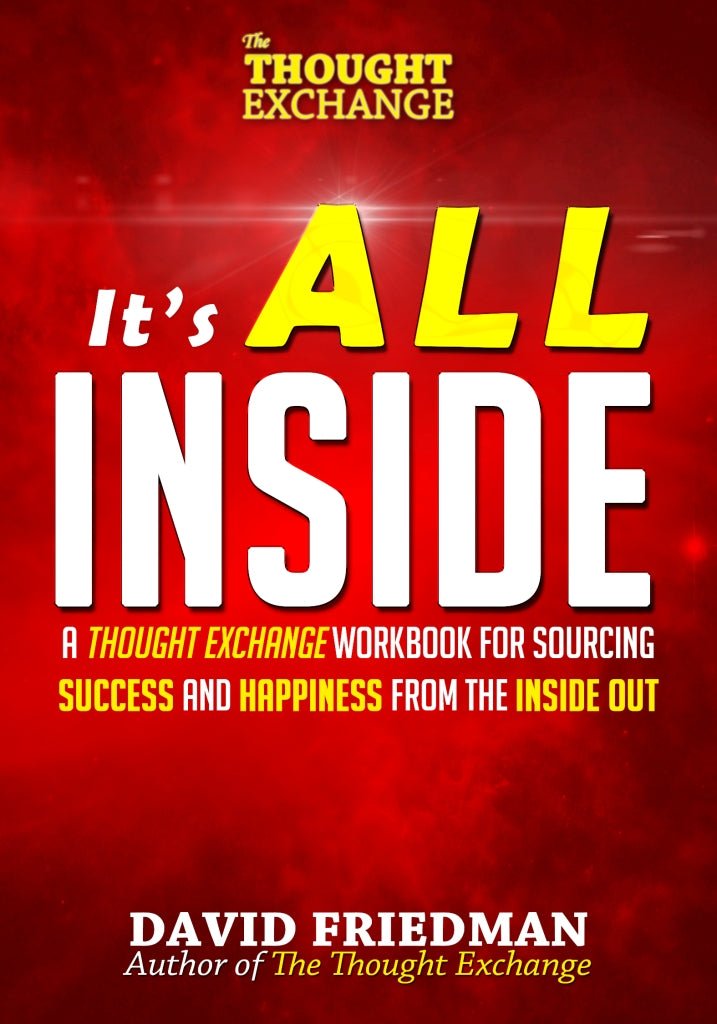
Its All Inside: A Thought Exchange Workbook
by David Friedman
As the fable goes, the Gods all got together to decide where they were going to hide the secret of life from Man. The first God said, “Let’s hide it up in the sky.